Part 2 – [Chapter 3]: MY DAUGHTER-IN-LAW SAID WE DIDN’T NEED ME ANYMORE — THEN MY ATTORNEY FINISHED WHAT I’D PREPARED FOR THEM
👉 Don’t worry, you’re still following the story.
THE PAPERWORK WAS FINISHED — BUT NOT THE WAY THEY THOUGHT
The next morning, I called Samuel before I made any decision.
I didn’t tell him I had changed my mind.
I didn’t tell him I was angry.
I simply asked him one question.
“Is it still possible to stop?”
There was a pause on the other end.
Then Samuel answered calmly.
“Yes.”
I closed my eyes.
I had spent the night thinking about the folder.
About Connor.
About Melinda.
About the house.
But more than anything, I had thought about one sentence.
We honestly don’t need you here anymore.
It wasn’t the cruelty of the words that stayed with me.
It was how easily they had been said.
And how easily my son had let them stand.
“Then don’t do anything with the paperwork yet,” I said.
Samuel understood immediately.
“You’re changing your mind?”
I looked around my bedroom.
At the photographs.
At the old wooden dresser Robert had chosen years ago.
At the house outside my window.
“No,” I said quietly.
“I’m changing what the paperwork means.”
For weeks, I had believed I was preparing to give Connor a future.
Now I understood that I had been preparing to give him something much more complicated.
A home.
The house wasn’t simply a property.
It was where Connor had grown up.
It was where Robert and I had spent years building a life.
It was where our family had celebrated birthdays, holidays, graduations, ordinary Sunday dinners, and countless evenings that none of us had realized would someday become memories.
I had imagined Connor and Melinda raising their children there.
I had imagined the rooms filling with their furniture.
I had imagined the photographs changing.
Maybe one day, there would be photographs of Jackson and Lily on the same sideboard where Connor’s childhood pictures had stood.
I had imagined myself visiting.
Not living there.
Not controlling anything.
Just visiting.
Being welcomed.
I had thought that was what a family did.
You gave when you could.
You helped when you were able.
You made room.
And you trusted the people you loved to understand that the gift came from love.
But the night before had shown me something I hadn’t wanted to see.
A gift can become invisible once someone believes it was always supposed to belong to them.
That was the part that hurt.
Not losing the opportunity to give the house.
Losing the belief that Connor understood why I was willing to give it.
Samuel called me back later that morning.
“I’ve reviewed everything,” he said.
“And?”
“The paperwork is complete as prepared.”
I understood what he meant.
The documents were ready.
The plan was ready.
But nothing had been transferred.
Nothing had changed hands.
The house was still mine.
The decision was still mine.
And for the first time, I felt grateful that I had asked one final question before allowing my generosity to become something permanent.
“What happens if I don’t go through with it?”
“Then the house remains yours.”
I nodded.
“And the documents?”
“We keep them on hold.”
I sat quietly.
Then Samuel said something that surprised me.
“You don’t owe anyone an explanation for changing your mind.”
I looked down at my hands.
“I know.”
“Do you?”
I smiled sadly.
“Yes.”
There was another pause.
Then he asked:
“Are you changing your mind because you’re angry?”
I thought about it.
“No.”
“Then why?”
I looked toward the window.
Because I loved my son.
Because I still did.
Because that was precisely why I couldn’t give him something he might someday believe he had been entitled to receive.
“Because I want the choice to remain a gift,” I said.
Samuel was quiet.
Then he answered:
“That makes sense.”
I ended the call.
And for the first time since the dinner, I felt calm.
Connor came by that afternoon.
Alone.
I saw his car through the window.
He sat inside for several minutes before getting out.
That told me something.
He wasn’t arriving with a plan.
He wasn’t arriving with Melinda.
He wasn’t arriving to demand an explanation.
He was thinking.
He finally walked to the front door and knocked.
I opened it.
He looked tired.
“Mom.”
“Come in.”
He stepped inside.
His eyes moved around the foyer.
Nothing had changed.
The same photographs.
The same small table.
The same coat rack.
The same house.
But I noticed something immediately.
He didn’t walk farther inside until I stepped aside.
That mattered.
It was a small thing.
But I noticed.
He looked at me.
“I’ve been thinking about last night.”
“So have I.”
“I shouldn’t have stayed quiet.”
I didn’t answer.
He swallowed.
“I knew what she said was wrong.”
I looked at him.
“Then why didn’t you say anything?”
He looked down.
“I was afraid.”
“Of what?”
He gave a tired laugh.
“Everything.”
He sat on the edge of the chair near the door.
“I was afraid Melinda would get angry.”
I waited.
“I was afraid we’d have a fight.”
Still I said nothing.
“I was afraid the whole dinner would fall apart.”
He looked at me.
“And I think I was afraid of admitting that what she said was actually true in one way.”
That surprised me.
“What do you mean?”
He looked down at his hands.
“I’ve gotten used to you being there.”
I didn’t move.
“I’ve gotten used to you helping.”
He paused.
“I’ve gotten used to you saying yes.”
His voice became quieter.
“And somewhere along the way, I stopped noticing that you were doing those things because you wanted to.”
I felt my throat tighten.
He continued.
“I started thinking that’s just what Mom does.”
There it was.
The sentence I had been waiting years to hear.
Not because I wanted him to feel guilty.
Because I wanted him to understand.
I sat across from him.
“Connor, I never wanted you to feel like you couldn’t ask me for help.”
“I know.”
“But asking is different from assuming.”
He nodded.
“I know that now.”
I looked at him.
“Do you?”
He didn’t answer immediately.
Then he said:
“I think I finally do.”
He noticed the folder on the table.
His eyes moved toward it.
“Is that the same folder?”
“Yes.”
He looked at it for several seconds.
“Is that what Samuel finished?”
“Yes.”
He swallowed.
“What’s inside?”
I could have told him.
Instead, I asked:
“What do you think is inside?”
He looked at me.
For a moment, he didn’t answer.
Then he said:
“Something about the house.”
I nodded.
He stared at the folder.
“Did you change something?”
“Yes.”
His face tightened.
“Because of us?”
“Because of what happened.”
He nodded slowly.
Then he asked the question I knew he had been afraid to ask.
“Were you going to give us the house?”
I didn’t answer immediately.
I wanted him to understand that the truth wasn’t something I should have been embarrassed about.
“Yes.”
He looked stunned.
“You were?”
“Yes.”
“When?”
“Before dinner.”
His eyes moved toward the folder.
“You were going to give it to us before she said those things?”
“Yes.”
He leaned back.
For several seconds, he simply stared at me.
Then he whispered:
“I didn’t know.”
“I know.”
“Melinda didn’t know.”
“I know.”
“You really were going to give us the house?”
“Yes.”
His eyes filled.
Not dramatically.
He looked away.
I gave him time.
Finally, he said:
“Why?”
I smiled faintly.
“Because you’re my son.”
He shook his head.
“No. I mean… why would you do that?”
“Because I wanted to.”
“But you didn’t have to.”
“No.”
“You could have kept it.”
“Yes.”
“You could have sold it.”
“Yes.”
He looked at me.
“So you were just going to give it to us?”
I nodded.
“Because I thought it would make me happy to see you build your family there.”
Connor covered his face with one hand.
For a while, he didn’t speak.
Then he said:
“And we sat at your table and told you we didn’t need you anymore.”
I didn’t answer.
He lowered his hand.
“I did.”
I looked at him.
“You didn’t say it.”
“No.”
“But you didn’t stop her.”
His eyes dropped.
“I know.”
That was the moment.
Not the folder.
Not the house.
Not the paperwork.
That was the real reveal.
Connor finally understood that he hadn’t lost something because his wife had said something cruel.
He had lost something because he had allowed his mother’s generosity to become invisible.
He stood and walked toward the window.
The backyard was quiet.
“You know what’s embarrassing?”
“What?”
“I thought I was protecting everyone.”
I looked at him.
“By staying quiet?”
“Yes.”
He shook his head.
“I thought if I didn’t respond, it would pass.”
He looked at me.
“I thought you would forgive us.”
I didn’t say anything.
He continued.
“That’s the worst part.”
“What?”
“I knew you would.”
His eyes filled again.
“I counted on it.”
That sentence stayed between us.
Because it was honest.
Painfully honest.
And sometimes honesty hurts more than an apology.
Connor wasn’t saying:
I didn’t mean to.
He was saying:
I knew you loved me enough to forgive me, and I relied on that love instead of protecting it.
I looked at my son.
“That is what has to change.”
He nodded.
“I know.”
“I don’t need you to become perfect.”
“I know.”
“I don’t need you to choose me over your wife.”
He looked surprised.
“I don’t?”
“No.”
I smiled.
“You and Melinda are a family. You should make decisions together.”
He nodded.
“But when those decisions affect someone else, you need to remember that person gets a voice.”
He looked down.
“I understand.”
“And when someone says something cruel about the person who raised you…”
He swallowed.
“You should speak.”
“Yes.”
He nodded.
“I should have.”
Melinda came later that evening.
She stood beside Connor at the door.
For a few seconds, she wouldn’t look at me.
Then she finally did.
“I owe you an apology.”
I didn’t answer immediately.
She continued.
“I thought you were holding Connor back.”
I listened.
“I thought he stayed because he felt responsible for you.”
My chest tightened.
“I thought once we had our own house, everything would become easier.”
I nodded.
She looked down.
“And I thought your help was something we would eventually outgrow.”
Her voice softened.
“I didn’t realize you were preparing to give us something.”
Connor looked at her.
She looked back at him.
“I didn’t know.”
“I know,” I said.
She looked at me.
“Would you have given us the house?”
“Yes.”
Her eyes widened.
“But now…”
I nodded.
“Now I won’t.”
She looked hurt.
But she didn’t argue.
That mattered.
Instead, she said:
“I understand.”
I looked at her carefully.
“Do you?”
She nodded.
“I think I do.”
She took a breath.
“I thought being independent meant not needing you.”
I smiled faintly.
“Being independent doesn’t mean treating people like they are unnecessary.”
She nodded.
“I know that now.”
There was no dramatic reconciliation.
No sudden embrace.
No promise that everything would be perfect.
Just three adults standing in a foyer, finally saying the things they should have said before anyone made a decision for anyone else.
And strangely, that felt more honest than any apology could have been.
The next week, Samuel finalized a different set of instructions.
The house remained mine.
The gift was no longer moving forward.
But I didn’t turn it into a weapon.
I didn’t tell Connor he had lost something.
I didn’t remind Melinda what they had almost received.
I didn’t use the house to make them feel guilty.
I simply kept it.
Because it was mine.
And because I finally understood something I should have understood years earlier:
Giving is meaningful only when the person giving remains free to choose.
I still loved Connor.
That hadn’t changed.
I still loved my grandchildren.
That hadn’t changed either.
And I didn’t hate Melinda.
She had been wrong.
Deeply wrong.
But people can be wrong without becoming monsters.
Sometimes they simply need to confront the consequences of their assumptions.
Melinda and Connor found another place.
It wasn’t as large as my house.
It wasn’t meant to be.
They rented it at first.
Then, months later, they started looking again.
This time, Connor didn’t assume I would help.
He didn’t ask for money.
He didn’t ask me to co-sign anything.
He didn’t ask me to sell the house.
He simply called.
“We’re looking at another place.”
“Do you like it?”
“I think so.”
“Then what are you waiting for?”
“I wanted to know what you thought.”
I smiled.
“Why?”
“Because I should have asked before.”
That sentence meant more to me than anything he could have bought.
Months passed.
The house remained quiet.
Sometimes Connor visited.
Sometimes Melinda came with him.
Sometimes the children stayed for the weekend.
The first few visits felt different.
Not bad.
Just different.
Connor asked before opening cabinets.
He asked before moving furniture.
He asked whether I wanted help with things.
He asked whether I needed anything.
At first, I noticed every question.
Eventually, I stopped noticing.
That was how I knew something had changed.
He wasn’t performing.
He wasn’t trying to prove he had learned a lesson.
He was simply behaving differently.
And that was the only apology that mattered.
One Saturday morning, Connor came by alone.
He stood outside the front door.
I saw him through the window.
He knocked.
I opened it.
He smiled.
“Hi, Mom.”
“Hi.”
He didn’t step inside.
He just stood there.
For a moment, neither of us said anything.
Then he asked:
“Can I come in?”
I looked at him.
And suddenly I remembered the moving truck.
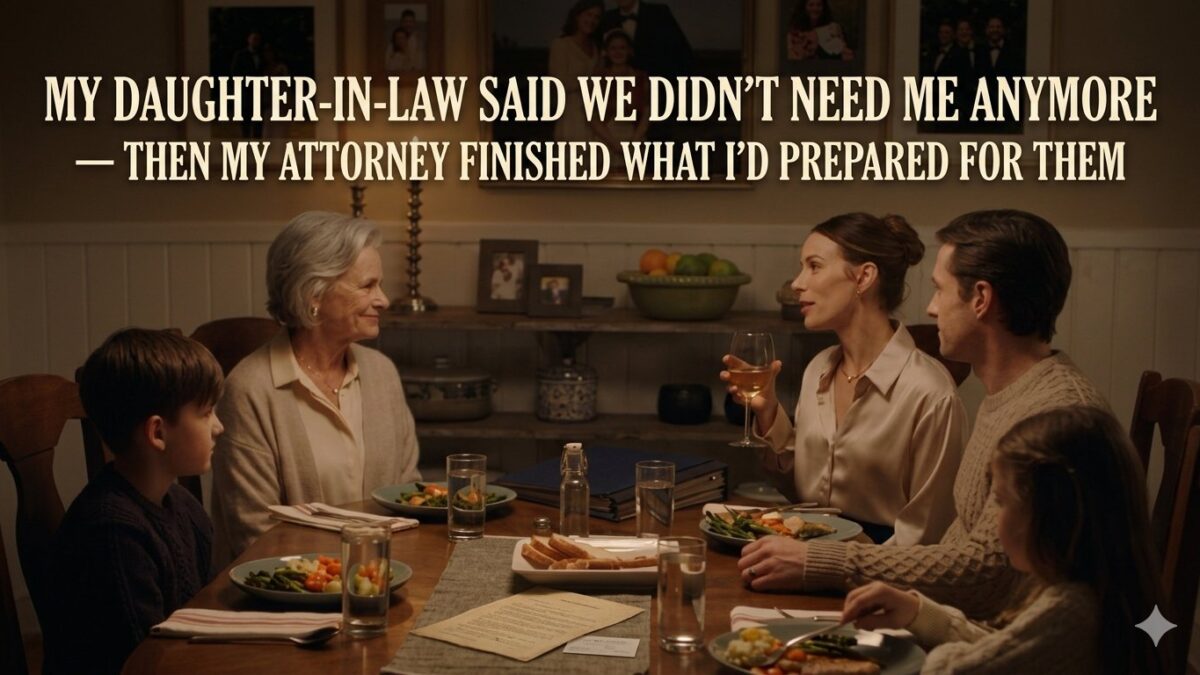
The dinner table.
Melinda’s wine glass.
His eyes fixed on his plate.
The napkin.
The navy-blue folder.
Samuel.
The sentence:
We honestly don’t need you here anymore.
And then I remembered the night before all of that.
The night I had sat alone believing I was preparing a gift for my son.
I looked at Connor standing on my porch.
Waiting.
Not assuming.
Not entering.
Waiting.
And I smiled.
“Yes.”
He stepped inside.
He looked around.
Then he said:
“I brought breakfast.”
I laughed.
“You didn’t have to.”
“I know.”
He smiled.
“But I wanted to.”
I looked at him.
That was the difference.
He finally understood.
We ate breakfast at the same table where everything had started.
The same wooden table.
The same chairs.
The same room.
The same home.
But it didn’t feel like the same place.
Connor told me about work.
I told him about something I had seen in the garden.
We laughed.
We argued lightly about whether I was watering the plants too much.
Then he stopped.
“Mom?”
“Yes?”
“Do you regret not giving us the house?”
I thought about it.
“No.”
He nodded.
“Are you disappointed in me?”
I looked at him.
“I was disappointed in what you did.”
He accepted that.
Then I added:
“But I don’t think one bad decision has to define a person forever.”
His eyes softened.
“Thank you.”
I smiled.
“Don’t thank me yet.”
He laughed.
“I know.”
I reached across the table.
He took my hand.
We sat that way for a moment.
No dramatic speech.
No promise.
Just a mother and her son.
I still have the navy-blue folder.
It sits in a drawer now.
Closed.
The papers inside no longer represent the future I once imagined.
But I don’t look at them with regret.
I look at them as a reminder.
Not of what Connor lost.
Of what I learned.
I had spent years believing that being a good mother meant making things easier for my son.
If he needed something, I helped.
If he was struggling, I made room.
If he made a mistake, I forgave him.
If he assumed I would understand, I did.
But there is a point where love becomes unhealthy if the person giving it disappears completely.
I had almost disappeared.
Not because Connor demanded it.
Because I had volunteered for the role.
I had made myself so available that eventually my availability looked like an obligation.
That was my part in the story.
Connor had his part too.
He had accepted what I gave.
Then he had begun assuming I would always give it.
Melinda had hers.
She had mistaken independence for separation.
She had believed that needing someone meant being controlled by them.
But in the end, none of them needed to lose everything to understand.
They only needed to lose the assumption.
The assumption that my love meant automatic access.
The assumption that my generosity was permanent.
The assumption that because I was their mother, my answer would always be yes.
A year later, Connor asked me something that made me smile.
We were standing in the kitchen.
He was helping me put away dishes.
He held a plate in one hand.
Then he looked at me.
“Mom?”
“Yes?”
“If someday you decide you want someone else to have this house…”
I waited.
He continued.
“Can I ask you something?”
“Of course.”
“Don’t give it to me just because I’m your son.”
I stared at him.
He smiled.
“Give it to whoever you think will take care of it.”
I felt tears come to my eyes.
“That sounds like something your father would say.”
“I know.”
He put the plate away.
Then he looked at me.
“And if you decide you want to keep it forever?”
I smiled.
“Then I keep it.”
He nodded.
“Good.”
He didn’t look disappointed.
That was how I knew he had changed.
He no longer measured my love by what I gave him.
Sometimes I wonder what would have happened if Melinda had never said those words that night.
If she had simply celebrated the house.
If Connor had looked at me and said he was proud of me.
If they had gone home believing the future was theirs to build.
Maybe I would have given them the house.
Maybe they would have lived there.
Maybe everything would have unfolded exactly as I once imagined.
But then I remind myself that families don’t grow through perfect moments.
They grow through difficult ones.
Through the conversations nobody wants to have.
Through mistakes.
Through boundaries.
Through the uncomfortable realization that loving someone doesn’t mean allowing them to decide what your love requires.
The night Melinda told me they didn’t need me anymore, I thought I had lost my place in my own family.
What I actually lost was something else.
An illusion.
The illusion that giving more would always make us closer.
It didn’t.
Sometimes giving more simply teaches people to expect more.
And sometimes the most loving thing you can do is stop.
Not to punish.
Not to hurt.
Not to win.
Just to remind everyone, including yourself, that love and permission are not the same thing.
Connor still visits.
Melinda still comes.
The grandchildren still run through the hallway when they arrive.
The house still has the same wooden floors.
The same photographs.
The same dining table.
And the same navy-blue folder hidden in a drawer.
Nothing about the walls changed.
But everything about the family did.
Connor learned to ask.
Melinda learned to listen.
And I learned that I could love my son without handing him every part of myself.
The house stayed mine.
But that wasn’t the victory.
The victory was sitting at my kitchen table months later and realizing I no longer needed to prove that I was worth respecting.
I simply expected it.
And when Connor came to my door again one Saturday morning, he didn’t walk in.
He knocked.
He waited.
And he asked:
“Can I come in?”
I opened the door.
And I said yes.
Not because I owed him.
Not because he was entitled to it.
Because this time, I was choosing it.
And that made all the difference.
❤️ If you enjoyed this emotional family story, there are many more powerful stories waiting for you on the web — filled with family secrets, difficult choices, unexpected twists, quiet betrayals, second chances, and endings that stay with you long after the final line.
You Might Also Enjoy
Part 2 – [Chapter 2]: MY DAUGHTER-IN-LAW SAID WE DIDN’T NEED ME ANYMORE — THEN MY ATTORNEY FINISHED WHAT I’D PREPARED FOR THEM
Part 2 – [Chapter 1]: MY DAUGHTER-IN-LAW SAID WE DIDN’T NEED ME ANYMORE — THEN MY ATTORNEY FINISHED WHAT I’D PREPARED FOR THEM