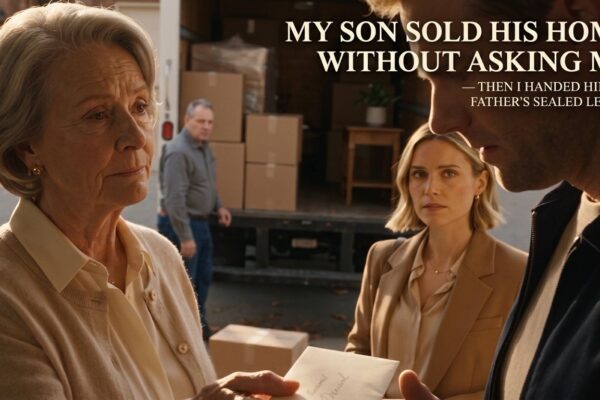
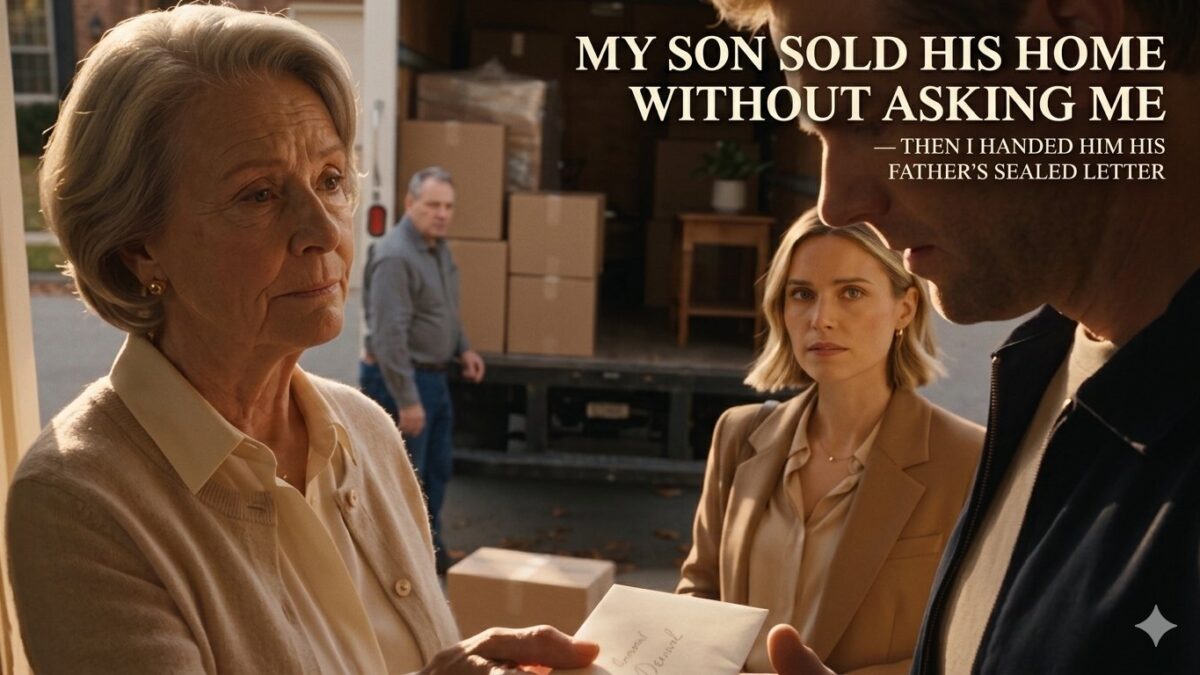
Part 2 – [Chapter 3]: MY SON SOLD HIS HOME WITHOUT ASKING ME — THEN I HANDED HIM HIS FATHER’S SEALED LETTER
👉 Don’t worry, you’re still following the story.
THE LETTER WAS NEVER ABOUT THE HOUSE
Daniel sat on the porch step with his father’s letter unfolded across both hands.
The afternoon light had begun to fade.
The moving truck was still parked in the driveway.
The boxes were still inside it.
Victoria was standing several feet away, unusually quiet.
And I was sitting across from my son, watching him read words written by a man who had been gone for four years.
Daniel had already read the first half.
Now he started again.
Slowly.
Carefully.
As though he were afraid that reading too quickly might make him miss something.
His eyes moved across the page.
Then stopped.
He swallowed.
And continued.
I didn’t ask what Robert had written.
I had waited four years for this moment.
I could wait another few minutes.
Finally, Daniel spoke.
“Dad said he knew I would think you were going to say yes.”
I nodded.
“He knew you.”
Daniel looked at me.
“He said something else.”
“What?”
“He said that wasn’t the problem.”
I waited.
Daniel lowered the letter.
“He said the problem would be if I stopped asking.”
The words settled between us.
There was no dramatic sound.
No sudden revelation outside the house.
Just the quiet rustling of leaves along the driveway.
But something inside Daniel had shifted.
He looked at the house.
Then back at the letter.
“Mom…”
“Yes?”
“Did Dad ever think I didn’t love you?”
I shook my head.
“No.”
“Did he think I was selfish?”
“No.”
“Then why did he write this?”
I looked at him.
“Because sometimes love doesn’t stop someone from making a mistake.”
Daniel looked down.
“Then what does?”
“Being willing to listen.”
He nodded slowly.
His thumb moved along the edge of the paper.
Then he read another paragraph.
His expression changed.
He read it again.
“What?”
He looked at me.
“He wrote about the house.”
My heart tightened.
“What did he say?”
Daniel looked back at the letter.
“He said…”
He stopped.
Then continued.
“He said if I ever found myself standing in front of your door believing I had already earned the right to walk through it, I should stop.”
I didn’t move.
Daniel’s voice became quieter.
“He said the house wasn’t mine.”
I nodded.
“He said it wasn’t yours either.”
I looked at him.
Daniel continued reading.
“He said the house belonged to the person who had spent a lifetime making it a home.”
He looked up.
“That was you.”
I smiled faintly.
“That sounds like your father.”
Daniel folded the paper slightly.
“But then he wrote something I don’t understand.”
“What?”
“He said I shouldn’t apologize for wanting a home.”
I looked at him.
That was important.
Robert hadn’t wanted Daniel to feel ashamed for needing something.
He had wanted him to understand the difference between needing help and assuming help was guaranteed.
Daniel continued.
“He said, ‘Your mother will probably give you more than you deserve because she loves you. That is exactly why you must never make her love carry the weight of your decisions.’”
I closed my eyes.
For a moment, I couldn’t speak.
That was Robert.
Even in death, he could say exactly what I needed to hear.
Daniel looked at me.
“Did he really say that?”
“Yes.”
“You remember?”
“I remember him saying something very close to it.”
Daniel looked at the page.
“He wrote that he wasn’t worried about me taking the house.”
I nodded.
“He was worried I’d take your choice.”
That sentence hurt.
Because it was true.
I looked toward the driveway.
The truck.
The boxes.
The life they had packed into cardboard.
That was what I had been unable to explain earlier.
They weren’t taking my house.
Not yet.
But they had already taken away something smaller.
They had taken away my opportunity to choose.
They had decided for me.
And perhaps that was why Robert had written the letter.
Not to protect four bedrooms.
To protect a conversation.
Daniel read further.
Then he stopped again.
His eyes remained on the paper for several seconds.
Finally he whispered:
“He knew.”
I looked at him.
“He knew what?”
“He knew I’d tell myself it wasn’t a big deal.”
I didn’t answer.
Daniel laughed softly.
There was no humor in it.
“I actually said that.”
“When?”
“On the drive here.”
Victoria looked at him.
“You did.”
Daniel nodded.
“I told you it wasn’t a big deal.”
Victoria looked down.
“I thought it wasn’t.”
Daniel looked at her.
“I know.”
Then he looked at me.
“I thought you would understand.”
“I know.”
He rubbed his face.
“I didn’t think I was hurting you.”
“I know.”
He stared at me.
“How can you keep saying that?”
“Because I believe you.”
That seemed to hurt him more than anger would have.
He looked away.
I continued.
“You didn’t come here trying to hurt me.”
“No.”
“You came here believing everything would work itself out.”
“Yes.”
“You believed I would adjust.”
He nodded.
“You believed because I had always made room for you before, I would make room again.”
He looked at the ground.
“Yes.”
“And you never stopped to ask whether I wanted to.”
Daniel’s eyes closed.
“I know.”
That was the first time he had said it without defending himself.
No explanation.
No “but.”
No mention of the condo.
No mention of the bedrooms.
Just:
I know.
Victoria sat beside him.
For a while, neither of them spoke.
Then she said quietly:
“I owe you an apology too.”
Daniel looked at her.
“For what?”
“I knew we hadn’t asked your mom.”
He stared at her.
“You knew?”
“I knew we hadn’t asked her directly.”
“Why didn’t you say something?”
Victoria looked at me.
“Because I thought you would say yes.”
I nodded.
She continued.
“And because I thought if Daniel’s mother loved him, she wouldn’t want him to struggle.”
I understood.
That was another uncomfortable truth.
People often mistake kindness for unlimited availability.
They see a generous person and assume generosity is a permanent condition.
Victoria looked at me.
“I was wrong.”
I didn’t tell her she was forgiven.
Not because I wanted to punish her.
Because forgiveness shouldn’t be something someone demands five minutes after causing harm.
Instead, I said:
“You were confident.”
She smiled sadly.
“I was.”
“And you were wrong.”
“Yes.”
Daniel looked at her.
She reached for his hand.
He held it.
That small gesture told me something.
They weren’t suddenly enemies.
They were still married.
Still a team.
But perhaps, for the first time, they were beginning to understand that being a team didn’t mean making decisions for someone else.
Daniel folded the letter.
“There’s one part I don’t understand.”
“What?”
He looked at me.
“Why did Dad make you wait?”
I knew the answer.
But I wanted him to discover it himself.
“What do you think?”
Daniel looked toward the street.
He was silent for a long time.
Then he said:
“Because he knew you would protect me.”
I nodded.
“And?”
“He knew if you gave me the letter too early, I’d read it as advice.”
“Yes.”
“And if you gave it to me when I was angry, I’d read it as criticism.”
“Yes.”
“And if you gave it to me when I thought I was right…”
He stopped.
“What?”
“I’d read it as an argument.”
I smiled.
“That sounds like your father.”
Daniel smiled too.
For the first time that afternoon, the tension softened.
Then he looked at the letter.
“So he wanted me to read it when I couldn’t pretend I didn’t understand.”
“Yes.”
Daniel looked down.
“I understand now.”
I waited.
He looked at me.
“The letter was never about the house.”
I felt tears gather in my eyes.
“No.”
“It was about me.”
“Partly.”
“And you.”
“Yes.”
“And Dad.”
I nodded.
“He wanted us to stop having this conversation about a house.”
Daniel looked at me.
“He wanted us to have a conversation about what happened to us.”
That was it.
The entire mystery.
The sealed envelope.
The four years.
The strange instruction.
The day Robert handed it to me.
The sentence I hadn’t understood.
Give it to him when he stops asking.
Robert had never been predicting a moving truck.
He had been predicting a habit.
He had seen something I hadn’t.
Daniel was becoming so comfortable with my love that he was beginning to confuse love with permission.
Not because he was a bad son.
Because I had made it easy.
Every time he needed something, I helped.
Every time he asked for flexibility, I gave it.
Every time he assumed I’d understand, I did.
And slowly, without either of us noticing, the questions disappeared.
The letter wasn’t Robert’s warning to Daniel.
It was his reminder to me, too.
Love your son. But don’t disappear inside that love.
Daniel stood.
He looked toward the moving truck.
Then at the boxes.
The decision on his face was quiet.
“What are you going to do?” I asked.
He looked at me.
“We’re not moving in.”
Victoria stood beside him.
She nodded.
Daniel walked toward the movers.
“Guys?”
The older man turned.
Daniel pointed toward the truck.
“Put everything back.”
One of the movers looked toward Victoria.
She nodded.
“Yes.”
The men began working.
One box at a time.
The process took nearly an hour.
A couch came back out of the truck and was carried toward Daniel’s vehicle.
Then several boxes.
Then a lamp.
Then a set of dining chairs.
Then the smaller things that suddenly seemed much heavier than they had when they were packed.
Daniel helped.
Victoria helped.
Nobody complained.
Nobody blamed anyone.
Nobody said:
This is your fault.
The truck slowly emptied.
My house slowly returned to the way it had been before they arrived.
But I didn’t feel victorious.
That surprised me.
I had imagined, in some distant part of my mind, that if Daniel ever understood what he had done, I would feel relieved.
Instead, I felt sad.
Because my son had never intended to make me feel invisible.
He had simply forgotten to look.
There is a difference.
And sometimes that difference is exactly what makes family conflicts so difficult.
If someone hurts you intentionally, you know where to place your anger.
When someone hurts you because they assumed your love would cover everything, you have to decide what to do with the love that remains.
I chose not to throw it away.
But I also decided I would never again confuse love with surrender.
By sunset, the driveway was empty.
The moving truck pulled away.
Victoria stood beside Daniel near their car.
He looked toward the house.
I stood on the porch.
For several seconds, neither of us moved.
Then Daniel walked toward me.
He stopped at the bottom of the steps.
“Mom.”
“Yes?”
“I don’t know how to fix this.”
I looked at him.
“You don’t have to fix everything tonight.”
“I want to.”
“I know.”
He swallowed.
“Can I come back tomorrow?”
The question was simple.
But it was the first question he had asked me all day.
I nodded.
“Yes.”
He looked relieved.
Then he turned and walked away.
I watched him leave.
Victoria followed.
Neither of them looked angry.
Neither looked defeated.
They looked thoughtful.
That was enough for one night.
I barely slept.
Not because I was angry.
Because I kept thinking about Robert.
Four years earlier, he had known that one day I would need to decide whether to keep protecting Daniel from difficult truths or allow him to face one.
I wondered whether he had known how painful that would be.
I wondered whether he had known that the hardest part of motherhood isn’t always watching your child struggle.
Sometimes it’s watching them realize they have hurt you.
Because when a child is young, you can correct them.
You can explain.
You can say:
Don’t do that.
But when your child becomes an adult, you can’t control the choices they make.
You can only decide what you will accept.
That was the part I had forgotten.
I didn’t need to stop loving Daniel.
I needed to stop making my love invisible.
The next morning, I heard a knock at the door.
It was just after eight.
I knew who it was before I opened it.
Daniel stood on the porch alone.
No truck.
No boxes.
No Victoria.
No plan.
Just him.
He looked tired.
His hair was slightly messy.
He was wearing the same jacket from the day before.
He held something in his hand.
The letter.
He had folded it carefully.
I opened the door.
He looked at me.
For a moment, neither of us spoke.
Then he said:
“Can I come in?”
I felt something inside me break.
Not painfully.
Gently.
Like a knot finally loosening after being pulled tight for years.
I stepped aside.
“Yes.”
He entered.
He didn’t walk toward the kitchen.
He didn’t head upstairs.
He didn’t look around the house as though imagining where his furniture might go.
He simply stood in the foyer.
Then he looked at the photograph of Robert.
“I finished the letter last night.”
“I know.”
“I read it three times.”
I smiled.
“What did you think?”
“I thought Dad was unfair.”
I raised an eyebrow.
Daniel smiled faintly.
“Then I thought he was right.”
“That sounds more like him.”
Daniel looked at the photograph.
“He said something else.”
“What?”
“He said you would probably forgive me too quickly.”
I laughed softly.
“That sounds like him too.”
Daniel smiled.
Then his expression became serious.
“He said forgiveness isn’t the same as permission.”
I nodded.
“He said if I wanted to rebuild our relationship, I couldn’t ask you to forget what happened.”
I looked at my son.
“That was wise.”
“He also said I shouldn’t make some huge promise.”
“Why?”
“Because promises are easy when you’re standing in front of the person you’ve hurt.”
I looked at him.
“What did he tell you to do?”
Daniel looked directly at me.
“Ask.”
I felt my eyes fill.
“Ask what?”
He took a breath.
“Ask what you want.”
I smiled.
“I want my son.”
He nodded.
“I know.”
“But I don’t want a son who thinks loving him means saying yes to everything.”
“I know.”
“And I don’t want you to be afraid to need me.”
He looked confused.
“I don’t understand.”
“You don’t have to stop asking for help.”
His eyes softened.
“You can ask.”
I continued.
“You can need me.”
He nodded.
“But you can’t decide for me.”
He looked down.
“I won’t.”
I smiled.
“Good.”
He stood quietly for a moment.
Then he asked:
“Can I sit with you?”
I nodded.
We walked into the kitchen.
The same kitchen where Robert had once sat with his cold coffee.
The same table.
The same chairs.
The same window overlooking the backyard.
Daniel pulled out a chair.
I sat across from him.
For several minutes, neither of us spoke.
Then he said:
“Mom?”
“Yes?”
“Why didn’t you ever tell me you felt this way?”
I thought about the question.
Because I could have.
I should have.
But I had spent years believing that protecting my son from disappointment was part of being a good mother.
“I didn’t want you to feel guilty.”
Daniel looked at me.
“And I didn’t want you to think my love came with conditions.”
He looked down.
“But I guess by never saying anything…”
“You let me assume.”
He nodded.
“I did.”
I reached across the table.
Not to excuse him.
Not to erase yesterday.
Just to remind him that love was still there.
He took my hand.
“I am sorry.”
“I know.”
“I really am.”
“I know.”
“And I’m going to ask next time.”
I smiled.
“Good.”
He squeezed my hand.
Then, after a moment, he asked:
“Would you ever want us to live here?”
I looked at him.
The question was almost funny now.
Not because of the answer.
Because of the fact that he had finally asked it correctly.
“I don’t know.”
He nodded.
“Okay.”
“And if I say no?”
“Then I figure something else out.”
I smiled.
“That sounds reasonable.”
He smiled too.
Then he looked toward the window.
“I think Dad would be happy.”
I followed his gaze.
“I think so.”
We sat there for a while.
No moving truck.
No boxes.
No argument.
Just a mother and her son sitting across from each other, finally having the conversation they should have had before either of them made a decision.
A week later, Daniel and Victoria found another place.
It wasn’t as large as their old condo.
It wasn’t perfect.
But it was theirs.
Daniel called me before signing the lease.
Not after.
Before.
He told me the price.
He told me where it was.
He told me they were thinking about it.
Then he asked:
“What do you think?”
I laughed.
“Why are you asking me?”
“Because Dad told me to start asking again.”
I smiled.
“Your father also told you to make your own decisions.”
Daniel laughed.
“He did.”
“Then make your own.”
“I think I’m going to.”
“Good.”
There was a pause.
Then he said:
“But I still wanted to ask.”
I closed my eyes.
For the first time in years, I felt something I hadn’t realized I had been missing.
Not control.
Not authority.
Not ownership.
Connection.
The kind that exists when someone doesn’t need you to say yes.
They simply want to know what you think.
Months later, the envelope was still in my desk drawer.
I had put it there after Daniel finished reading it.
The paper had been folded and unfolded so many times that the edges had softened.
Sometimes I took it out.
Not to reread it.
Just to remember.
Robert had been right about one thing.
The day Daniel stopped asking would matter.
But he had been wrong about something else.
It wasn’t the end of our relationship.
It was the moment we finally had the chance to change it.
Daniel hadn’t lost his mother.
I hadn’t lost my son.
We had simply lost an old version of our relationship.
The version where I said yes before he asked.
The version where he assumed I would understand.
The version where love meant making everything easier.
We replaced it with something harder.
Something more honest.
Something that required two adults to speak clearly.
To listen.
To accept no.
To ask.
To answer.
And sometimes, to wait.
I think that’s what Robert had wanted all along.
Not to protect my house.
Not to control Daniel.
Not to leave behind one final warning.
He wanted his son to understand that the people who love us most still deserve a choice.
That kindness doesn’t mean unlimited access.
That family doesn’t mean automatic permission.
And that sometimes the most loving thing a person can say is:
“Let me ask what you want.”
I never gave Daniel the house.
I didn’t need to.
He didn’t need me to.
He needed something far more important.
He needed to remember that I was a person before I was his mother.
And I needed to remember that being his mother didn’t mean I had to disappear inside his needs.
The moving truck had arrived that afternoon believing it was carrying furniture into my home.
Instead, it carried away an old assumption.
The assumption that because I loved my son, he never had to ask.
It took one sealed letter from a father who had been gone for four years to make both of us see it.
And the strangest part was this:
The letter had never really been about the house.
It had been about a question.
A simple question.
A question my son had forgotten how to ask.
And one I hoped he would never forget again.
“What do you want, Mom?”
Sometimes love doesn’t need a grand gesture.
Sometimes it only needs someone to stop…
and ask.
❤️ If you enjoyed this emotional story, there are many more powerful stories waiting for you on the web — filled with family secrets, difficult choices, unexpected twists, quiet betrayals, second chances, and unforgettable endings.
You Might Also Enjoy
Part 2 – [Chapter 3]: MY DAUGHTER-IN-LAW SAID WE DIDN’T NEED ME ANYMORE — THEN MY ATTORNEY FINISHED WHAT I’D PREPARED FOR THEM
Part 2 – [Chapter 2]: MY DAUGHTER-IN-LAW SAID WE DIDN’T NEED ME ANYMORE — THEN MY ATTORNEY FINISHED WHAT I’D PREPARED FOR THEM